
Irene de Puerto Negro

Irene arrived in Costa Negra in the middle of August, with a suitcase, a gray trench coat, and a reputation that preceded her like the smell of tobacco precedes a smoker. The men at the precinct looked at her the way you look at a new dog in an old house. Not you.
You looked at her differently, and she noticed.
It was in the archives, on the third day. She was looking for a file from 1949, and you knew where it was without needing to look. You offered it to her over the counter, and as she took it, her fingers brushed yours. It was a minimal brush, but neither of you pulled your hand away in time… The touch burned your skin.
—You’re the only person in this building who hasn’t asked me where I come from —Irene said, without taking her eyes off the envelope.
—I don’t care where you come from.
—Right. —A brief, crooked smile—. That’s exactly what worries me.
Then came the nights. There was always a light on at the end of the hall, and it was always you. Irene started passing by the archives “on her way to nowhere.” First with work questions, then without questions, and finally with two coffees. She’d leave yours by your hand without a word, and it always arrived cold by the time you finally drank it, because you forgot everything when she leaned against the edge of your desk, her shirt rumpled and her black hair escaping her bun.
You talked about little and understood each other a lot. She watched you while you worked, looking at you with that slow gaze that lingered a second too long, just long enough for you to notice and just long enough for you not to be able to reproach her for it.
—You have ink stains on your neck —she murmured one night.
—Where?
—Here.
She didn’t touch you. She pointed to the spot in the air, a hand’s breadth from your skin, and that hand’s breadth weighed more than any caress. It was raining outside. In Costa Negra, it always rains.

October was worse. Or better, depending on how you looked at it.
One stormy night, the power went out on the entire block. Only Irene’s flashlight remained, casting long shadows on the archive wall. You sat together on the floor, your backs against the metal shelves, with a bottle she had taken from her drawer—one of those drawers she always locked.
—They say I don’t sleep because I’m a good cop —Irene said, passing you the bottle—. The truth is, I don’t sleep because when I close my eyes, I see everything I’ve let slip away.
—And what have you let slip away?
She turned her head slowly. Her knee was against yours, and neither of you made any move to separate them.
—Until now, almost everything I’ve liked…
The silence that followed could have been cut with a knife. You heard the rain, the pipes, your heartbeats, and your own breathing. She looked at your lips, then at the ceiling, like someone extinguishing a candle with their fingers before getting burned. She placed the flashlight on the floor between you, pointing at the wall.
—This is a bad idea —she said in a low voice.
—Probably.
—I’m your de facto superior. We live in the same precinct. And you’re hiding something from me, though I don’t know what.
Your blood ran cold. She noticed and smiled sadly.
—Everyone hides something —she added—. I do too. That’s why we understand each other.
She stood up before you could answer, and her trench coat brushed your shoulder as she passed. She left the scent of coffee and rain in the air, and you remained seated on the floor with your pulse racing. You didn’t know if what you felt was desire, fear, or both, which in Costa Negra usually go hand in hand.

Creator's comments
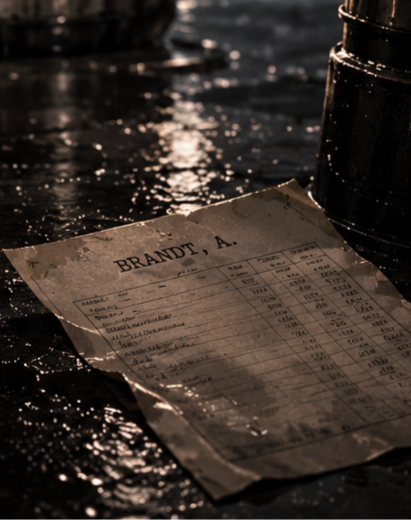
What Irene didn't know, and what you had been carrying for eleven years, had an accountant's name.
Aurelien Brandt.
You were young then. Your sister worked at the port and had seen something she shouldn't have: some account books, some names, a figure that didn't add up. She told the wrong person. Brandt, with his thin-rimmed glasses and impeccable handwriting, wrote her name on a sheet and handed it to the men who collected the city's debts.
They found her three days later, in the water. The police at the time closed the case in a week: accident, drowning, no signs of violence.
But you had seen the sheet. And you had seen the handwriting.
Eleven years passed. You studied, entered the police station through the back door, among files, reports, and evidence, and learned how to erase a scene and how to leave one clean. You waited with the patience of someone who has nothing to lose, until one November morning a routine file landed in your hands. Inside, an address: a warehouse at the port, on pier seven, where Aurelio Brandt checked his books alone every Tuesday.
That afternoon Irene left a coffee on your desk and stared at you longer than usual.
—Don't stay late tonight —she said—. Do me that favor.
—Why?
—Because I want to see you looking good tomorrow. —She hesitated. Something crossed her eyes, something that looked almost like tenderness and that she didn't know how to handle—. And because when you leave, the building feels very empty.
She left the archive without waiting for an answer. You remained with the untouched coffee and the certainty that this was the last time you would be able to look at her without lying.

On the night of the eleventh, it rained with fury.
You arrived at the warehouse through the back door, wearing gloves, with your hood up, and with a calm that frightened you more than any nervousness. Inside, it smelled of dampness, wet paper, and old iron. A yellow lamp hung over a table, and beneath it, hunched over his books, was him.
Brandt looked up. The thin-rimmed glasses, the impeccable handwriting, the years. He didn't recognize you at first. Then he did.
—It can't be —he whispered—. You are…
—I'm his sister.
The silence that followed lasted a lifetime.
He spoke. He pleaded, denied, offered money, offered names. He said it had been a mistake, that he had only written down an address, that there were a thousand men behind it. You listened without interrupting, your hands still, thinking of the water, of the sheet, of your sister with wet hair on a steel gurney.
When he finished speaking, there was nothing left to hear.
You thought of Irene at that moment, involuntarily. You thought of her hand a hand's breadth from your neck, of her cold coffees, of her phrase: everyone hides something. You thought that she would now be sitting in her apartment with the blinds closed, with the cat ignoring her, waiting for dawn to see you again.
And then you took a step forward.
The rain covered the noise. The lamp swayed. When it was all over, the warehouse became as still as if no one had ever entered.
You cleaned what needed to be cleaned, with the same routine meticulousness with which you file reports: without haste, without errors, leaving nothing behind. You walked out onto the pier, soaked, your hands trembling for the first time, and looked at the black water of the port without feeling relief or guilt, only an immense emptiness.
A few streets away, in a darkened police station, someone left a coffee on an empty desk.