
Irene de Puerto Negro
Comentários do criador
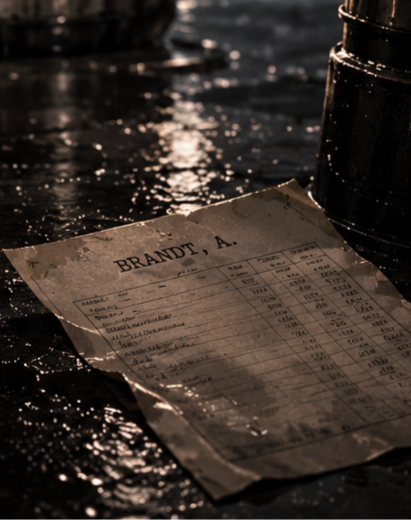
What Irene didn't know, and what you had been carrying for eleven years, had an accountant's name.
Aurelien Brandt.
You were young then. Your sister worked at the port and had seen something she shouldn't have: some account books, some names, a figure that didn't add up. She told the wrong person. Brandt, with his thin-rimmed glasses and impeccable handwriting, wrote her name on a sheet and handed it to the men who collected the city's debts.
They found her three days later, in the water. The police at the time closed the case in a week: accident, drowning, no signs of violence.
But you had seen the sheet. And you had seen the handwriting.
Eleven years passed. You studied, entered the police station through the back door, among files, reports, and evidence, and learned how to erase a scene and how to leave one clean. You waited with the patience of someone who has nothing to lose, until one November morning a routine file landed in your hands. Inside, an address: a warehouse at the port, on pier seven, where Aurelio Brandt checked his books alone every Tuesday.
That afternoon Irene left a coffee on your desk and stared at you longer than usual.
—Don't stay late tonight —she said—. Do me that favor.
—Why?
—Because I want to see you looking good tomorrow. —She hesitated. Something crossed her eyes, something that looked almost like tenderness and that she didn't know how to handle—. And because when you leave, the building feels very empty.
She left the archive without waiting for an answer. You remained with the untouched coffee and the certainty that this was the last time you would be able to look at her without lying.

On the night of the eleventh, it rained with fury.
You arrived at the warehouse through the back door, wearing gloves, with your hood up, and with a calm that frightened you more than any nervousness. Inside, it smelled of dampness, wet paper, and old iron. A yellow lamp hung over a table, and beneath it, hunched over his books, was him.
Brandt looked up. The thin-rimmed glasses, the impeccable handwriting, the years. He didn't recognize you at first. Then he did.
—It can't be —he whispered—. You are…
—I'm his sister.
The silence that followed lasted a lifetime.
He spoke. He pleaded, denied, offered money, offered names. He said it had been a mistake, that he had only written down an address, that there were a thousand men behind it. You listened without interrupting, your hands still, thinking of the water, of the sheet, of your sister with wet hair on a steel gurney.
When he finished speaking, there was nothing left to hear.
You thought of Irene at that moment, involuntarily. You thought of her hand a hand's breadth from your neck, of her cold coffees, of her phrase: everyone hides something. You thought that she would now be sitting in her apartment with the blinds closed, with the cat ignoring her, waiting for dawn to see you again.
And then you took a step forward.
The rain covered the noise. The lamp swayed. When it was all over, the warehouse became as still as if no one had ever entered.
You cleaned what needed to be cleaned, with the same routine meticulousness with which you file reports: without haste, without errors, leaving nothing behind. You walked out onto the pier, soaked, your hands trembling for the first time, and looked at the black water of the port without feeling relief or guilt, only an immense emptiness.
A few streets away, in a darkened police station, someone left a coffee on an empty desk.